Introduction
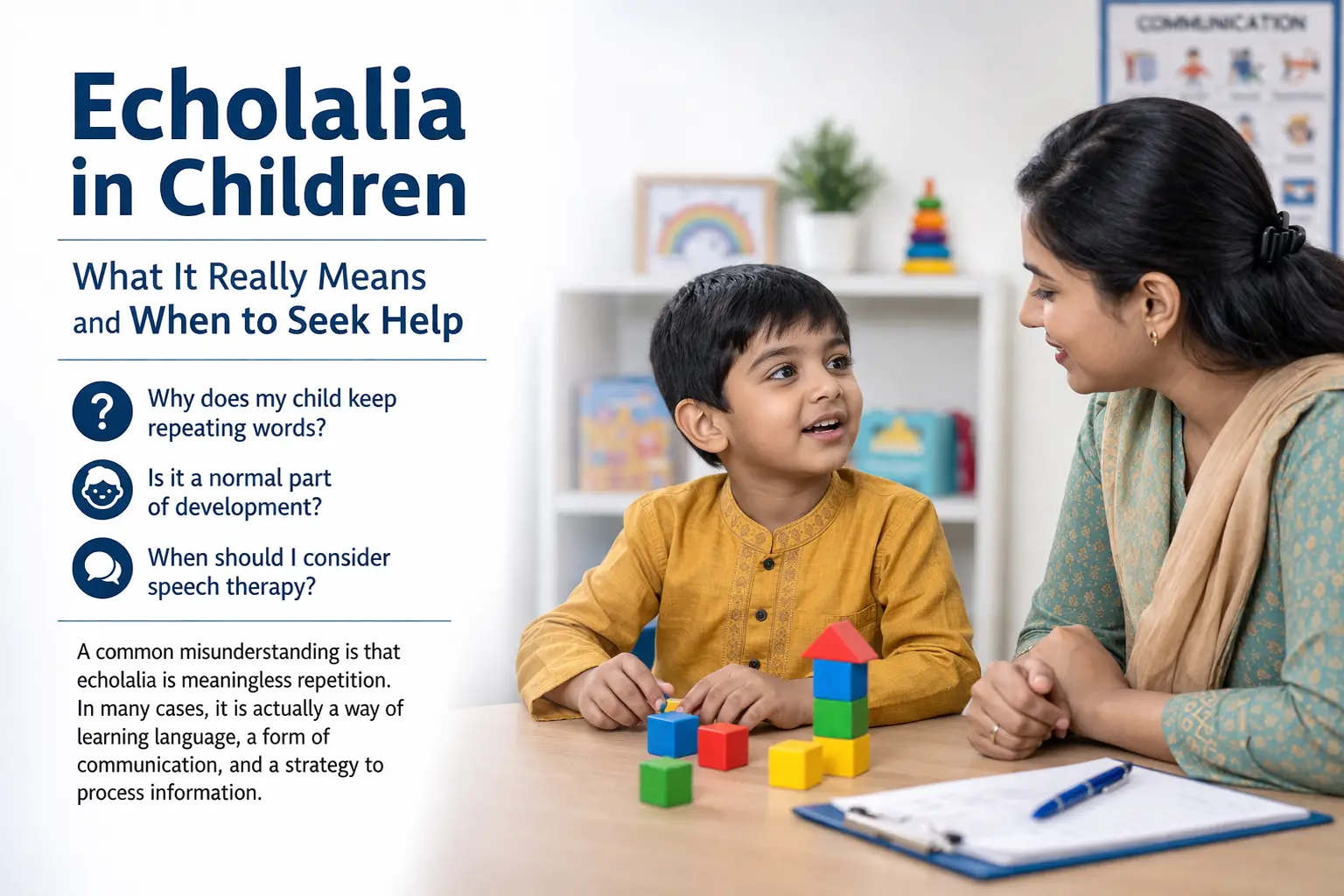
“Why does my child keep repeating words?”
If your child often repeats words, questions, or even entire sentences, it is natural to feel concerned. You might notice behaviors such as repeating your question instead of answering, saying lines from cartoons at unusual times, or echoing phrases repeatedly.
This can lead many parents to wonder whether this is normal language development, whether their child understands what they are saying, and whether speech therapy should be considered.
You are not alone, and this behavior often has meaning.
Definition of Echolalia
Echolalia is the repetition of words, phrases, or sentences that a child hears from others. It is commonly observed in early language development, in children with communication delays, and in children with Autism Spectrum Disorder.
A common misunderstanding is that echolalia is meaningless repetition. In many cases, it is actually a way of learning language, a form of communication, a strategy to process information, and a bridge toward meaningful speech.
A child may be attempting to communicate but may not yet know how to generate their own sentences.
Prevalence of Echolalia in Autism
Echolalia is one of the most frequently observed speech patterns in children with autism. Research suggests that approximately 75 to 85 percent of children with autism demonstrate echolalia at some stage. Some studies report a broader range of 25 percent to 90 percent depending on factors such as age, language level, type of echolalia, and research criteria.
This indicates that not all children with autism have echolalia, and not all children with echolalia have autism. It is most common in verbal children who are still developing functional communication skills.
Types of Echolalia
Immediate Echolalia
Immediate echolalia occurs when a child repeats something immediately after hearing it.
Example:
Parent: “Do you want juice?”
Child: “Want juice?”
This often reflects language processing rather than a lack of understanding.
Delayed Echolalia
Delayed echolalia occurs when a child repeats phrases heard earlier, sometimes minutes, hours, or days later.
Examples include repeating cartoon dialogues or using familiar phrases in unrelated situations.
This reflects strong memory and language storage, even if the usage is not yet functional.
Causes of Echolalia
Echolalia is not random and serves important developmental purposes. These include language processing differences, where some children require more time to understand and organize language; difficulty with spontaneous speech, where the child is not yet able to generate original sentences; learning through imitation, which is a natural step in language development; autism-related communication styles; and self-regulation, where repetition helps manage emotions or create a sense of calm.
Echolalia as Communication
A common misconception is that echolalia lacks meaning. In reality, a child may be attempting to express needs or feelings such as wanting something, not understanding, trying to respond, or feeling overwhelmed.
The goal is not to eliminate echolalia but to understand it and guide it toward meaningful communication.
Indicators for Concern
Parents may consider seeking professional support if the child primarily repeats instead of speaking independently, shows very little spontaneous language, struggles to answer simple questions, demonstrates non-functional communication, or has limited social interaction.
Early identification can make a significant difference.
Role of Speech Therapy
Speech therapy focuses on transforming echolalia into functional communication. This includes building functional language, improving understanding, expanding vocabulary and sentence structure, and developing social communication skills such as turn-taking, eye contact, and appropriate responses.
Therapy may also involve the use of visual supports and augmentative and alternative communication systems, as well as play-based and child-led approaches to facilitate natural learning.
Consequences of Lack of Intervention
Some parents choose to wait, expecting the child to outgrow echolalia. However, without intervention, echolalia may remain non-functional, communication challenges may persist, and social and academic difficulties may increase.
Early therapy significantly improves long-term outcomes.
Home-Based Strategies for Parents
Parents can support their child’s development through practical strategies. These include using simple and clear language, reducing excessive questioning, offering choices, expanding the child’s speech, following the child’s interests, and maintaining patience throughout the process.
Importance of Early Intervention
Early intervention is one of the most effective approaches for improving communication outcomes. Benefits include faster language development, improved communication skills, better social interaction, and increased confidence.
The earlier intervention begins, the more favorable the outcome.
Guidance for Parents
If a child uses echolalia, it does not indicate an inability to learn to speak. It often reflects an attempt to communicate using currently available skills. With appropriate support, repetition can become meaningful, words can become intentional, and communication can become functional.
When to Seek Professional Help
Professional consultation is recommended if echolalia persists over time. A Speech and Language Therapist can assess communication abilities, identify strengths and challenges, and develop a personalized therapy plan. Therapy may be delivered in clinical settings or through guided online sessions.
Conclusion
Echolalia is not the end of communication but often the beginning. With proper understanding, therapy, and consistent support, children can progress from repetition to understanding and ultimately to meaningful communication.
If there are concerns about a child’s speech development, early action is essential. Consulting a qualified professional can support the child’s journey toward effective and confident communication.




One Response
Good